What Is Codicology? And What About Paleography?
A Growing Primer
This section introduces selected codicology and paleography topics. It is not an exhaustive reference. If there is a script or manuscript type you would like to see covered, open an issue.
What Does “Codicology” Mean?
The term codicology is traced to Alphonse Dain, a French scholar of Byzantine and Hellenic studies. In Les manuscrits (1949), he proposed it as a single English term for the study of manuscripts. Dain noted that German already had the term Handschriftenkunde. He formed codicology from the Latin codex or codicis, meaning “book,” and the Greek -logia, meaning “the study of a subject.” The word therefore means the study of books, especially manuscripts.
Codicology is a broad field, but it does not encompass every aspect of manuscript study. Paleography, from the Greek palaios and graphein, is the study of ancient handwriting and scripts, including those found in manuscripts. For examples, see Caroline Minuscule, Humanistic Script, and Beneventan Script. Paleography is distinct from, but complementary to, codicology, with its own methods, terminology, and theories.
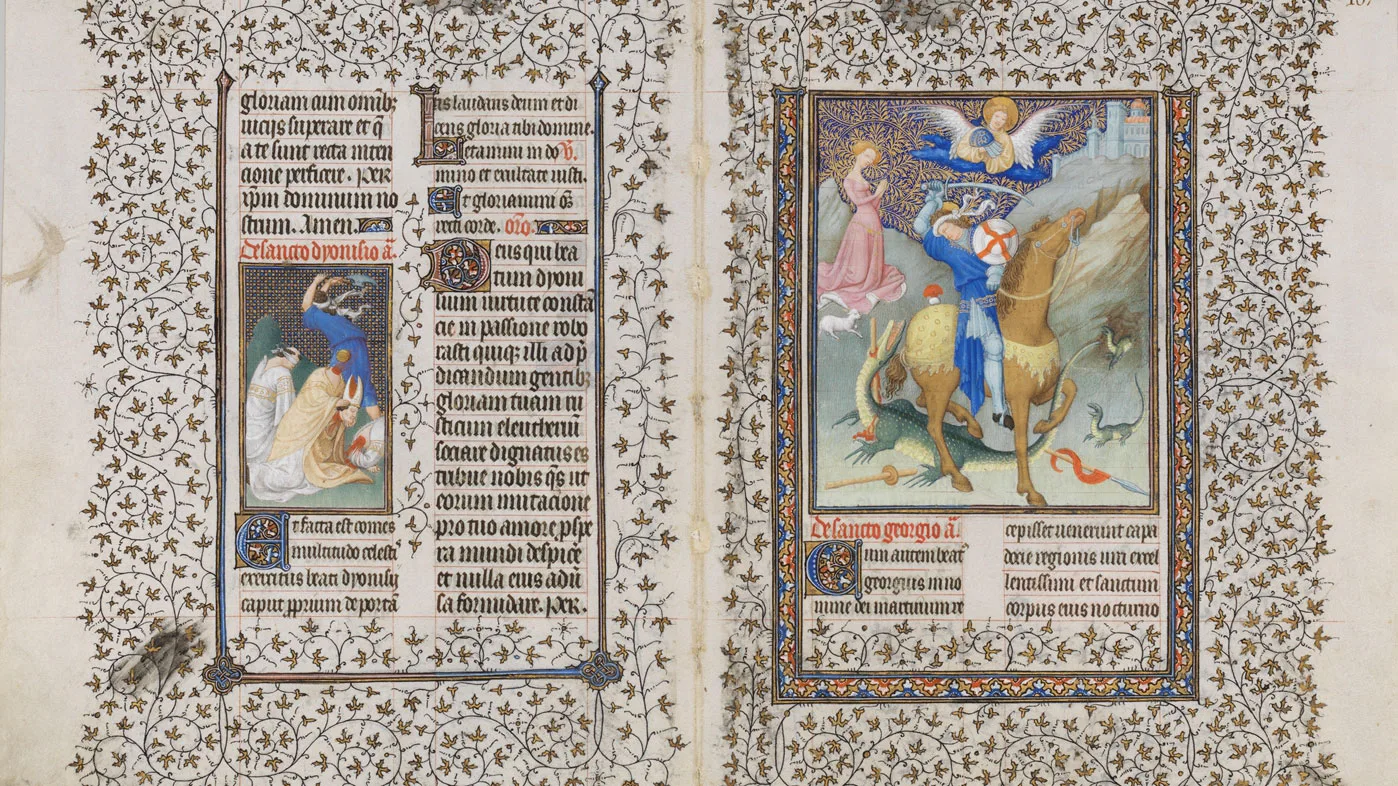 The Belles Heures of Jean de France, duc de Berry, f 166v 167r
Codicology and Paleography
Codicology and paleography both help us study manuscripts. They can overlap in practice, but they begin with different questions.
- Codicology focuses on the physical book. By studying a manuscript’s materials, binding, layout, and other features, a codicologist can learn about its origin, provenance, dating, and use by past owners. (Timothy Hunter, “Codicology,” The Oxford Companion to Western Art, Oxford University Press, 2001.) Codicology generally moves from the whole book to its smaller parts.
- Paleography focuses on scripts and handwriting. By analyzing how words are written, a paleographer can also investigate a manuscript’s place of origin and date. (Peter Beal, “palaeography,” A Dictionary of English Manuscript Terminology 1450–2000, Oxford University Press, 2008.) Paleography often begins with a specific feature of the writing and works outward to the wider history of the book.
The distinction is not always straightforward. Both disciplines aim to improve our understanding of a manuscript and its origins, but they approach that goal from different directions. Some researchers consider codicology part of paleography, while others take the opposite view. (Peter Beal, “codicology,” A Dictionary of English Manuscript Terminology 1450–2000, Oxford University Press, 2008.)
No single term encompasses every question raised by a medieval book. Depending on your interests and approach, you may work as a paleographer or a codicologist. When you need help with a particular feature or problem, seek the advice of someone with relevant expertise.
For example, a paleographer might suggest that manuscript Hatton MS 116, Oxford, Bodleian Library, was once at Worcester because its glosses were written by the Tremulous Hand of Worcester. A codicologist might reach the same conclusion by examining the parchment, binding, and layout. Both approaches are valuable research methods.
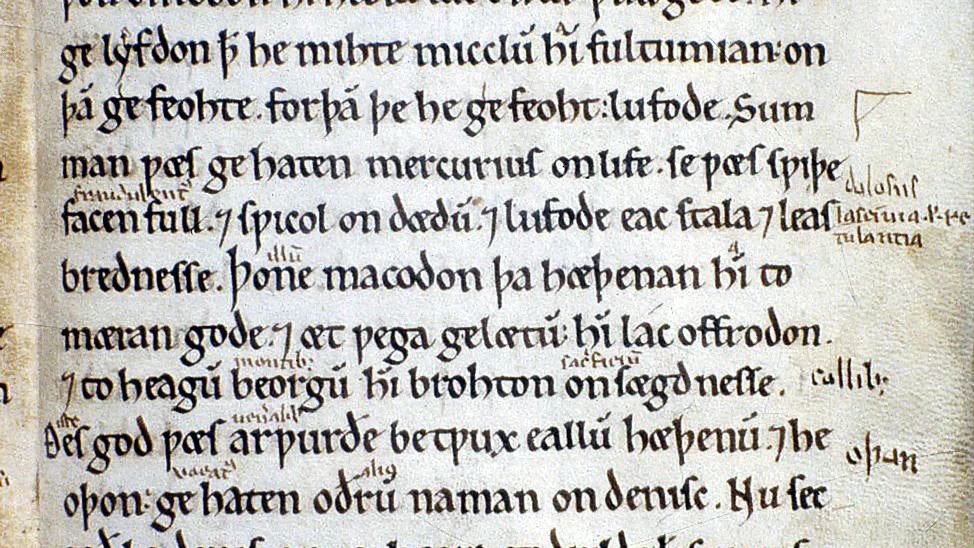 Oxford, Bodleian Library, Hatton 116 — browse the Bodleian's digitized manuscripts on the DMMapp
Find Digitized Manuscripts!
DMMapp is a small, independent project and a labor of love, fueled by a passion for history, culture, and medieval manuscripts. For more than a decade, we have gathered links to digitized medieval manuscripts from archives and libraries around the world.