Bastarda (Littera Bastarda, Littera Hybrida)
Littera Bastarda was a medieval script commonly used in Europe during the fourteenth and fifteenth centuries. It combines features of Gothic and Humanistic styles and appears in legal documents, religious texts, and other late-medieval manuscripts.
Origin and Characteristics
Littera Bastarda, also known as Bastard Script or Bastarda, is thought to have originated in the early fourteenth century, possibly in France or England. It was a transitional script that combined Humanistic influences, rooted in classical Roman writing, with the Gothic script prevalent in medieval Europe.
The Littera Bastarda was a cursive script with a number of unique features. It was characterized by its irregular, fluid strokes and its mix of Gothic and Humanistic letterforms. The script was also known for its use of ligatures — the joining of two or more letters into a single glyph — which helped save space and improve legibility, important for legal documents and other official records.
Like many medieval manuscripts, it also uses abbreviations. These save space and speed writing, but can make the text difficult for modern readers to read.
Usage and Importance
Littera Bastarda was widely used in late-medieval Europe for charters, deeds, wills, religious texts, literary manuscripts such as works by Chaucer, and personal correspondence.
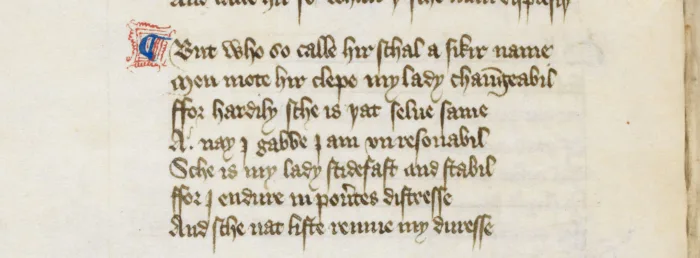 Example of Littera Bastarda in Harley, ms 4866, fs001r — The British Library.
Littera Bastarda is important because it forms a bridge between Gothic and Humanistic styles. It reflects a period of cultural change as Renaissance ideas influenced art, literature, science, and writing.
Its ligatures and abbreviations influenced early printing typefaces, and its irregular strokes helped inspire italic typefaces.
Decline and Legacy
The Littera Bastarda began to decline in popularity in the late 15th century, as the Humanistic script became more dominant in Europe. However, it continued to be used in certain regions, such as Spain and Portugal, well into the 16th century.
Despite its decline, Littera Bastarda has had a lasting legacy. Its blend of Gothic and Humanistic letterforms has inspired modern typefaces, and its use of ligatures and abbreviations continues to influence typography and graphic design.
Legacy
Littera Bastarda remains important to the history of European writing, typography, and graphic design. Calligraphers, typographers, and historians continue to study its blend of Gothic and Humanistic elements. Surviving documents and manuscripts provide valuable insight into medieval life and the importance of preserving cultural heritage.
Bibliography
- Brown, Michelle P. A Guide to Western Historical Scripts from Antiquity to 1600. University of Toronto Press, 1990.
- Clemens, Raymond, and Timothy Graham. Introduction to Manuscript Studies. Cornell University Press, 2008.
- Clouse, Doug. "The Development of Type." In The Art of Letterpress Printing: A Handbook for Beginners. Bloomsbury Publishing, 2011.
- Derolez, Albert. The Palaeography of Gothic Manuscript Books: From the Twelfth to the Early Sixteenth Century. Cambridge University Press, 2003.
- Evans, M. B. W. A Handlist of English Manuscripts in the Old Royal Library, British Museum. British Museum Publications, 1962.
- Haselhoff, Gisela. Deutsche Schreibschrift: Geschichte, Lesen, Schreiben. Philipp Reclam Jun., 2002.
- Johnston, Edward. Writing & Illuminating & Lettering. Dover Publications, 1994.
- Parkes, M. B. Pause and Effect: An Introduction to the History of Punctuation in the West. University of California Press, 1993.
- Parkes, M. B. "The Influence of the Humanistic Bookhand on Some Gothic Scripts." Transactions of the Cambridge Bibliographical Society, vol. 6, no. 2, 1973.
- Prescott, Andrew. The Palaeography of Early English Manuscripts. Cambridge University Press, 1990.
- Brown, Michelle P. Understanding Illuminated Manuscripts: A Guide to Technical Terms. Getty Publications, 1994.
- Clemens, Raymond, and Timothy Graham. The Cambridge History of the Book in Britain: Volume 2, 1100–1400. Cambridge University Press, 2008.
Want to see Littera Bastarda manuscripts yourself? The British Library's digitized manuscripts are one of hundreds of collections on the DMMapp.