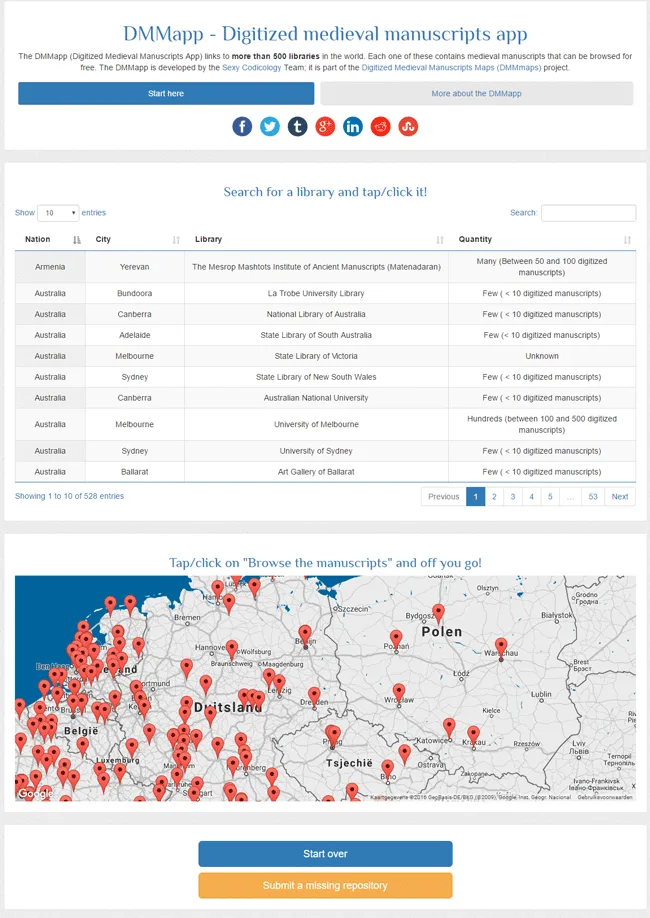
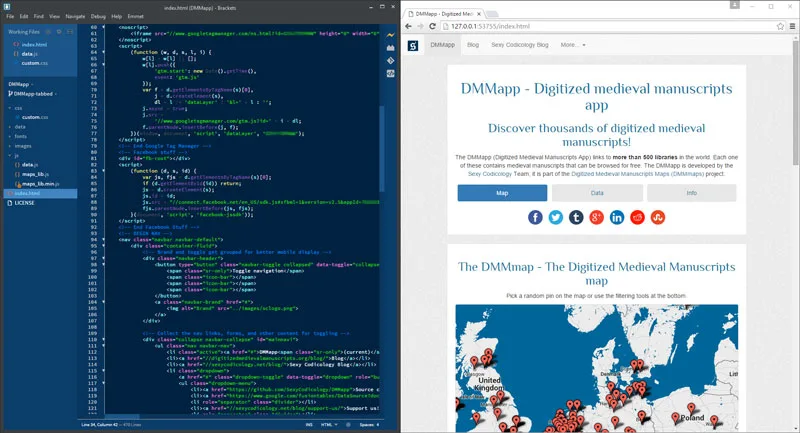
As you might have read in our previous post concerning the DMMapp 3.0, one of the best features is that now we can easily see which links in our database are broken, along with quickly adding what we receive via the missing library form.
We have been working hard, and we are super-proud to announce that the DMMapp 3.0 is out there and available for everyone to explore and enjoy!
Critics say:
"It's the best DMMapp yet!""It just works!""10/10 would DMMapp again"
No they don't, but we like to imagine they do! Let's go and see what has happened in the past months.
"We are dedicated to making digitized collections as easy to access as possible." That's the objective of the DMMapp Beta. Since its release, the DMMapp has been linking digital repositories to it users; but we believe it can always be better. That is why we have been reworking the app and are now releasing a public beta version for users to test and give us feedback.
With this release we particularly wanted to address various issues, mainly regarding performance and usability.
How does one describe an amazing experience that involves history, Italy, pizza and a ton of amazing medieval manuscripts coming from the most famous monastery in Southern Italy? Let's try starting from the beginning: From June the 29th until July the 3rd we had the privilege of attending the first Cassino Summer School, or better, the first International Summer School in Cassino (Italy): Trends in Manuscript Studies - Sources, Issues and Technologies, organized by Liber, Libro e Ricerca, and it was great; we would like to share the experience with you readers.
One of my biggest passions has always been astronomy: studying the names of the stars, the constellations' myths, the planets' movements. This passion has often met my other big love, medieval manuscripts, in the form of awesome astronomical manuscripts. The combination has always been fascinating to me: "Wow, someone hundreds (or thousands) of years ago was looking at the same stars I am looking at today, and was in love as much as me with the spectacle!" If you have ever had a chance to browse through an astronomical manuscript, you will have certainly noticed one thing: the constellations represented on parchment only seldom resemble the ones we see in the night sky. Sometimes, they look just like random dots.
Let's go and give a look at one of such books; an extraordinary one, to be precise, created more than a thousand years ago: the Leiden Aratea.
Well, this is the third time here at Sexy Codicology that we are delighted to communicate that the Vatican Library has, once again, digitized and made available a few hundreds new manuscripts!
Since we started the DMMmaps project, the Vatican Library has more than doubled the number of digitally available books. Plus, they have reorganized the home page: Where once you could see the endless list of manuscripts available (now 1'500+!), there is now a tidier page showing the collections and then number of digitized books you may find inside.
An old problem is still present: it is impossible to know which were the most recently uploaded books; unfortunately there is no RSS, nor is there any specific announcement which tells us what is new.
Too bad. I guess it is up to us users to explore!
What do you do with a super-awesome manuscript like the Utrecht Psalter? You make a super-awesome website to go with it. Not only: you make super-awesome YouTube videos to promote it, and catchy animations so that also casual visitors will be intrigued by what is being shown; plus you make sure that you spread the word on the right social media channels to gain visibility.
This is exactly what the University of Utrecht (Universiteit Utrecht) has been doing. A message appeared recently on our Facebook page:
The Utrecht Psalter, currently owned by the Utrecht University Library, has just been nominated for UNESCO's Memory of the World Register. In 2015, UNESCO will decide whether the medieval manuscript will be given a place in this documentary heritage register. Dating back to the ninth century, the Utrecht Psalter is one of the most valuable manuscripts held in a Dutch collection. Check the new website (with complete digitized version of the psalter): www.utrechtpsalter.nl
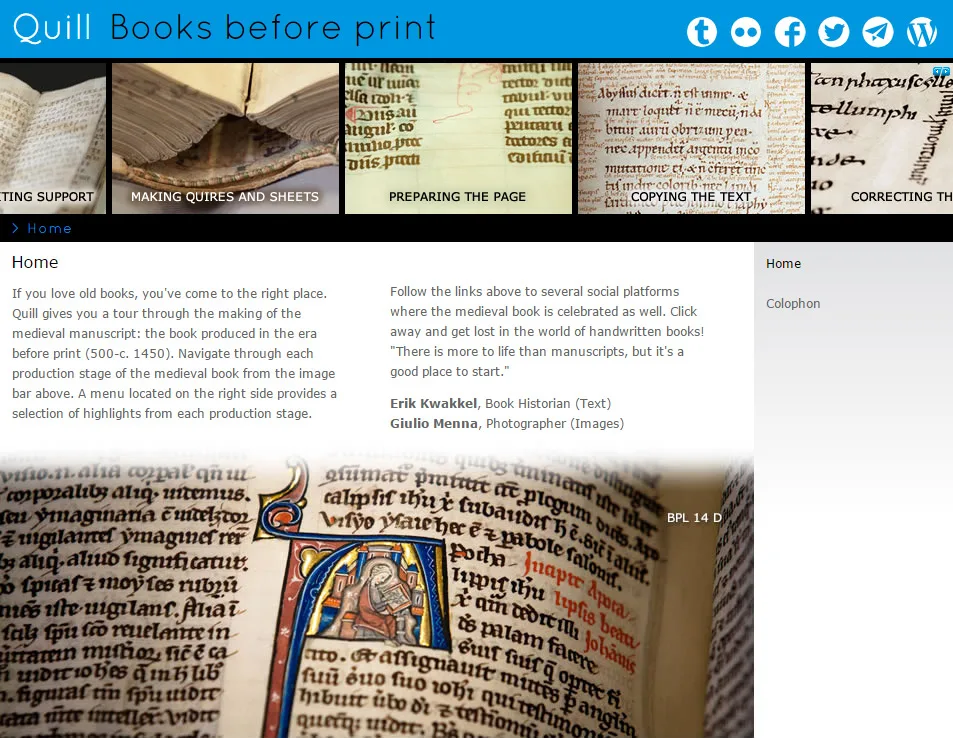
As you surely know, "Quill" was recently launched. Quill is a website a new website for medieval manuscript lovers put together by Dr. Erik Kwakkel, who had the idea, took care of the texts and made sure it'd be a success, and I, who had the pleasure of taking care of the photos. Erik put together a fantastic blog post about it, to which I contributed too. I ended up writing a bit too much for it, so it had to be reduced a bit in length in the end.
A super-cool website about medieval manuscripts has gone online today!
"This is to alert you to a new product of the "Turning Over a New Leaf” project: a website (in English) devoted to the medieval manuscript, aimed at a non-expert audience: https://quill.leiden.edu/. Some sixty web pages take you through the different production stages of the manuscript, and highlight important facets of the book before print. Short explanatory texts are paired with beautiful photographs, produced by Giulio Menna, professional photographer and co-producer of the website.
Quill went live today and was two years in the making. It was produced with funding of De Jonge Akademie, logistical support of Leiden University Centre for the Arts in Society (LUCAS), and with generous help of Leiden University Library, Special Collections."