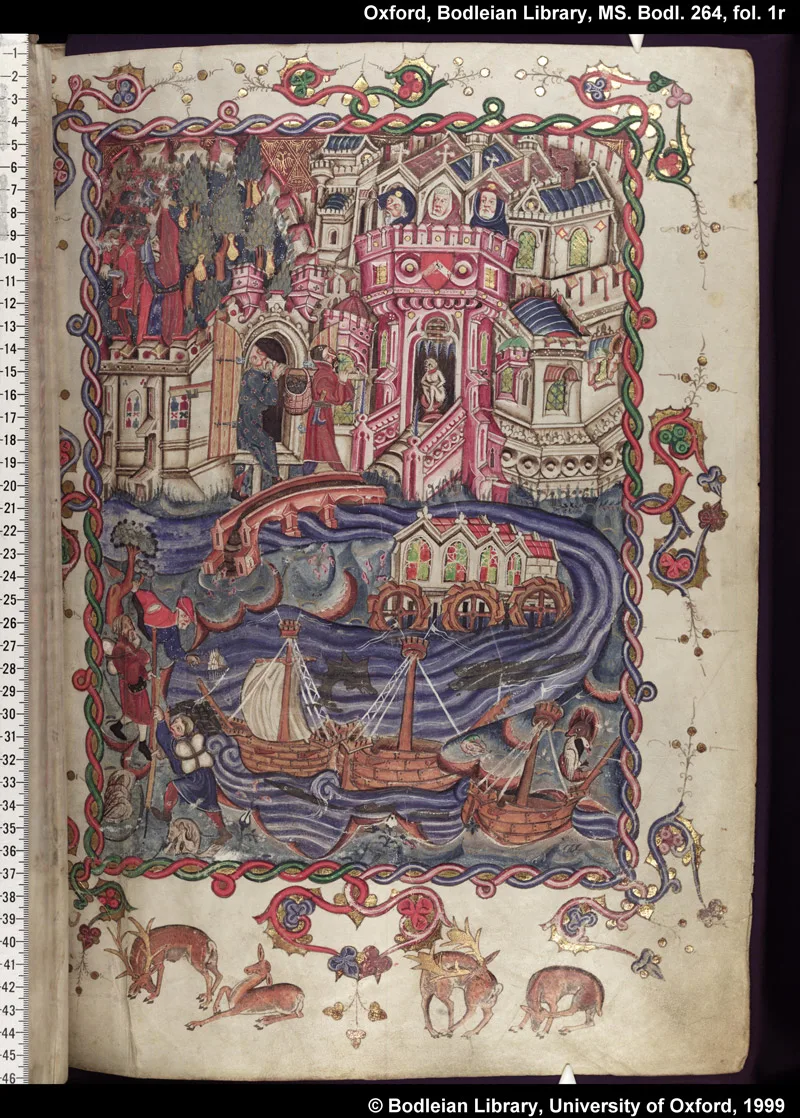
This morning a woke up to an email from my father. It was an article from the digital edition of his favorite Italian newspaper. The title of the article is: 'Il sovrano che Unì Est ed Ovest', or: The Sovereign that United East and West. Unfortunately the newspaper's app shares the article, but excludes the author's name from it, but it's dated 20/07/14.
The article carefully explains how the three books contained in Oxford Bodley 264 (and a facsimile created byIstituto dell’Enciclopedia Italiana) are connected.
June has been a productive month for the DMMmaps project: we were at the DH Benelux Conference in The Hague, Netherlands, presenting this project, but we have also received many new links to that were added to the database. So, without further ado, let's present the additions:
Since the last couple of years, more and more universities are participating in collaborations where they create so-called MOOCs (Massive Open Online Courses). These are a way for anyone that is interested to participate in open-access, free from costs university courses. The courses are basically on any kind of subject you can think of: from art and history to literature, computer science and medicine. You can find lists of courses on pages like Coursera and Futurelearn. I just finished a six-week course on Futurelearn by the University of Southampton about the archaeology of the old Roman port of Rome, Portus. My experiences with this were so good, I decided to also enroll for England in the time of King Richard III which is offered by the University of Leicester also on Futurelearn.
One of the biggest news items in the field of archaeology last year was the discovery and identification of the (in)famous King Richard III under a parking lot in Leicester. Now, the University from this same city has created a six-week course starting coming Monday 30th of June about all sorts of aspects of the time of this King of England.
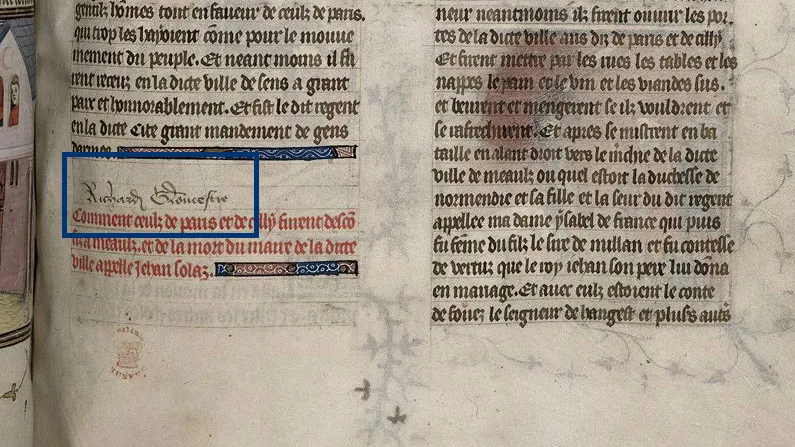
You might wonder, however, how this connects to codicology and medieval manuscripts. Richard III was a medieval king during a time of change in the field of book history. Handwritten books were less produced and printing was on the rise. This English king might not have had one of the most famous libraries, but nevertheless a very important one. He was one of the few people in high society of those days that signed his books.
e-Codices, the Virtual Manuscript Library of Switzerland, has added 31 new digitized medieval manuscripts to their website. Obviously, we had to go and investigate. The new digitized manuscripts range from the 9th to the 18th century. Difficult to choose which ones to highlight since they are all wonderful to our eyes. Let's start from the one they have highlighted themselves.
One of my most beautiful experiences as an MA student in the Netherlands was field trip I did with my colleagues to the deep south of the Netherlands. In an abbey we went through three different libraries searching for fragments in early modern books. What I ended up finding was a full-page pastedown of a manuscript written in Italy in the 13th century. What a beauty it was, still today I think about it...
Schafe für die Ewigkeit - Handschriften und ihre Herstellung, or: Sheep for Eternity - Manuscripts and their Production, is the name given to the 2013 / 2014 St. Gallen Abbey Library exhibition, running from 1 December, 2013 to November 9, 2014. A couple of weeks ago I became the lucky winner of the exhibition's catalog.
As you might have read on our Facebook Page, Twitter, Tumblr, or basically anywhere our social media empire stretches, the Sexy Codicology team was at the Digital Humanities Benelux Conference (or DH Benelux) 2014: "A conference that showcases the state of the art in digital humanities, the most recent development in humanities research.", organized by the Huygens Institute for the History of the Netherlands and the National Library of the Netherlands (Koninklijke Bibliotheek).
Useless to say, we are deeply honored and incredibly proud to have had the possibility to present the DMMmaps project to various experts and like-minded people from around the world.
If you couldn't be there, but you are interested to know what I have said during my part of the speech at the conference, I have posted it all on Medium. In this I explain how the DMMmaps project works, what services we use, how we make them interact.
I also explained the issues and the limits that the project faces (economical and technical ones).
Please feel free to comment here or directly on Medium. Any suggestion on how to improve the project is very welcome!
A quick update from the DMMmaps project: we have added 3 digital libraries in Estonia.
Today we posted on the Sexy Codicology Tumblr a post concerning a manuscript coming from the Tallinn city archives, Estonia. After a little investigation, I noticed that these archives were not in the DMMmaps database. I followed the link in the original post by booksnbuildings and found that there were two other institutions that had digitized manuscripts available online.
You can now find the Eesti Ajaloomuuseum - Estonian History Museum, the Estonian Historical Archives, and the Tallinn City Archives directly on our map, Together with other 324 digital libraries.
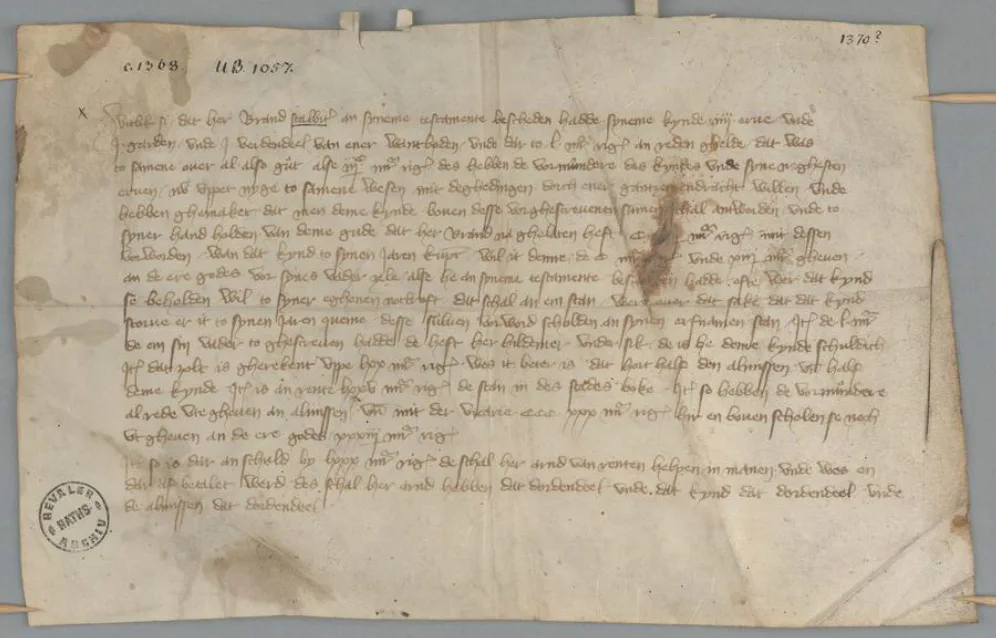
These three institutions deliver together 1217 digital objects. Most are deeds, testaments, and concessions. Some books can be found for sure, but I haven't had the time to explore the whole collection.
Nonetheless, these are extremely interesting documents that are very well digitized. No doubt that they will be useful to many researchers! I'll leave you with some of the examples of what you can find. Have fun exploring!