There is so much to do! We have succesfully migrated the articles from the DMMapp blog to the Sexy Codicology blog; HTTPS is here too. Plus, we recently posted the article about the humanistic script. It is part of our "Medieval Scripts" section. Facebook is doing nice!
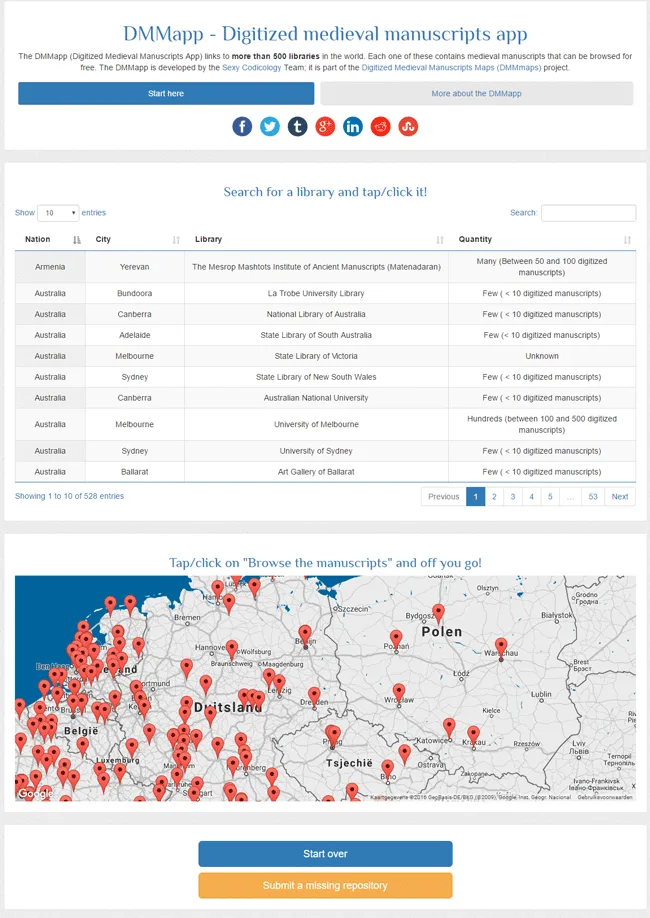
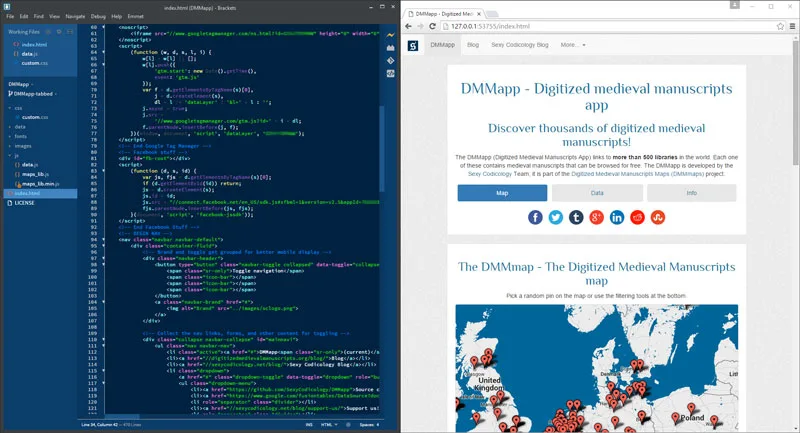
As you might have read in our previous post concerning the DMMapp 3.0, one of the best features is that now we can easily see which links in our database are broken, along with quickly adding what we receive via the missing library form.
We have been working hard, and we are super-proud to announce that the DMMapp 3.0 is out there and available for everyone to explore and enjoy!
Critics say:
"It's the best DMMapp yet!""It just works!""10/10 would DMMapp again"
No they don't, but we like to imagine they do! Let's go and see what has happened in the past months.
"We are dedicated to making digitized collections as easy to access as possible." That's the objective of the DMMapp Beta. Since its release, the DMMapp has been linking digital repositories to it users; but we believe it can always be better. That is why we have been reworking the app and are now releasing a public beta version for users to test and give us feedback.
With this release we particularly wanted to address various issues, mainly regarding performance and usability.
The Biblioteca de la Universidad de Barcelona one of the many new digitized libraries to the DMMapp (we are now at 500+!). The link to the Barcelona University Library was given to us through a tweet from @Archivalia_kg (he also has an excellent blog in German!)
Marlay cutting It. 12 - The Burial of St Monica at Ostia (left) and St Augustine Departing for Africa (right).
That little jewel in the in the center of Cambridge that is the Fitzwilliam Museum is home to an extraordinary collection of paintings, engravings, and most importantly for us, digitized medieval manuscripts. These manuscripts are available online (and linked in our app) so we went to give a look to see what wealth is available to us.
As someone who loves manuscripts and medieval culture, you might one day end up in Belgium, exploring Flanders, and you might go to Bruges, which was flourishing in the Middle Ages. The area has produced countless beautiful manuscripts with a very typical and recognizable style of illuminations now preserved at the Public Library of Bruges.
Bruges’ golden days were in the Middle Ages when it was a very prosperous harbor city that attracted many merchants. The historical city centre today is still much like it was in the Middle Ages which makes it an amazing place to visit for every medievalist (or everyone. Period).
While you are there, there is also a library you should visit: the Openbare Bibliotheek Brugge (OBB) - Public Library of Bruges and its extensive collection, which you can visit here or here.
We are extremely proud to communicate that the DMMapp has now reached (and surpassed... we are adding a few in the next days!) the 400 links milestone! This means that, thanks to everyone's submissions, we can link to more than 400 libraries, archives, repositories, etc. that are home to digitized medieval manuscripts! You can find the latest additions on our tidy list. Also, here's a short list of the latest additions:
How does one describe an amazing experience that involves history, Italy, pizza and a ton of amazing medieval manuscripts coming from the most famous monastery in Southern Italy? Let's try starting from the beginning: From June the 29th until July the 3rd we had the privilege of attending the first Cassino Summer School, or better, the first International Summer School in Cassino (Italy): Trends in Manuscript Studies - Sources, Issues and Technologies, organized by Liber, Libro e Ricerca, and it was great; we would like to share the experience with you readers.
One of my biggest passions has always been astronomy: studying the names of the stars, the constellations' myths, the planets' movements. This passion has often met my other big love, medieval manuscripts, in the form of awesome astronomical manuscripts. The combination has always been fascinating to me: "Wow, someone hundreds (or thousands) of years ago was looking at the same stars I am looking at today, and was in love as much as me with the spectacle!" If you have ever had a chance to browse through an astronomical manuscript, you will have certainly noticed one thing: the constellations represented on parchment only seldom resemble the ones we see in the night sky. Sometimes, they look just like random dots.
Let's go and give a look at one of such books; an extraordinary one, to be precise, created more than a thousand years ago: the Leiden Aratea.